



Abstract created by Good Solutions AI
In abstract:
- Macworld examines the MacBook Professional’s 20-year evolution, highlighting 5 pivotal fashions that reworked computing from the unique Intel Core Duo model to right this moment’s Apple Silicon powerhouses.
- The transition from PowerPC to Intel processors in 2006 enabled thinner designs and higher efficiency, whereas Apple Silicon later revolutionized effectivity and battery life in comparison with sizzling, loud Intel chips.
- Future MacBook Execs might function OLED shows and touchscreen know-how by 2026-2027, probably repeating the revolutionary affect of earlier generations.
Anybody searching for a brand new pc as of late could be smart to take a look at the MacBook Professional. It’s simply top-of-the-line laptops on this planet and combines energy and portability in ways in which most of its rivals can solely hope to match.
However how did Apple’s flagship laptop computer get right here? This week marks the twentieth anniversary of the first-ever MacBook Professional, giving us an excellent alternative to look again at the place the machine got here from and the place it could possibly be headed sooner or later. Listed below are 5 of crucial MacBook Professional fashions we’ve seen thus far, and all of the methods they’ve modified the world of computing perpetually.
MacBook Professional debut (2006)
Previous to 2006, Apple’s laptops had hit one thing of a useless finish. They used PowerPC chips that had powered the Mac for years, however Apple was struggling to eke any extra efficiency out of them with out ramping up energy consumption. That was an issue with laptops that would rapidly get heat.
Enter Intel processors. Nowadays, we would have a look at Intel chips as terribly inefficient in comparison with Apple silicon, however again within the mid-2000s, they have been a (figuratively) sizzling property. Apple determined to make the change, and on the similar time, determined to ditch the PowerBook branding fully and substitute it with the MacBook Professional.

At WWDC 2005, Intel CEO Paul Otellini (proper) joined Steve Jobs on the keynote deal with to announce Apple’s change to Intel processors.
Foundry
As Steve Jobs defined on stage when he unveiled the MacBook Professional for the primary time, Intel chips didn’t simply give higher total efficiency, they gave higher efficiency per watt, as much as 4.5 instances higher than the PowerPC G5 that got here earlier than.
All that meant that Apple may lastly do what it wished to do with its pro-level laptops. The ensuing MacBook Professional was full of an Intel Core Duo chip, was made thinner than the PowerBook, got here with a built-in iSight digicam for video calls, and launched the world to the much-loved MagSafe connector. It was a serious overhaul of Apple’s laptop computer lineup, and such a vital one that the MacBook Professional identify continues to be going robust right this moment.
All-in-one unibody (2008)
Earlier than 2008, the MacBook Professional’s chassis was constructed from a number of totally different parts, together with an inside body, a prime palm relaxation, a number of becoming a member of and strengthening parts, and extra. That was acceptable sufficient, however Apple wished one thing that was stronger and would assist the machine last more. To do this, it needed to rethink the way it made its MacBooks, and the end result was the creation of the unibody design.
This alteration meant that as an alternative of being constructed from a number of items that have been fitted collectively, the MacBook Professional’s physique was now milled from a single piece of aluminum that was whittled down till it was the precise form. Inner parts have been then fitted inside this enclosure, finishing the machine.
Consequently, the MacBook Professional grew to become far, far stronger whereas additionally being a lot lighter. Whereas the 2008 MacBook Air had used a unibody palm relaxation, that 12 months’s MacBook Professional was the primary Apple laptop computer to be fully constructed on this means. It’s a blueprint that MacBooks of all stripes have adopted ever since.
The 2008 MacBook Professional wasn’t nearly its unibody design. It additionally got here with highly effective Nvidia graphics choices, a bigger trackpad with multi-touch and help for clicking anyplace on its floor, and a brilliant LED show that was an impressively slim a part of the machine. However whereas it was much less showy than any of those parts, the unibody chassis has had simply as a lot of an affect, strengthening and simplifying the laptop computer’s case within the nearly 20 years since.
Retina show (2012)
The Retina show first appeared in 2010 within the iPhone 4 and the iPod contact, however didn’t make its strategy to the MacBook Professional till two years later. In 2012, Apple was able to raise the lid on a brand new pro-level laptop computer that includes the show tech that everybody was speaking about.
With a Retina show in impact, the pixels on the MacBook Professional’s display screen have been too small to discern from a standard viewing distance. That helped to sharpen up every little thing you considered in your machine, giving a way of crispness and high quality that was missing earlier than.
Elsewhere, the 2012 MacBook Professional was vital for a wealth of different causes. Its chassis was 25 % thinner than its predecessor, it got here with SSD storage as normal, it dropped the optical drive and FireWire 800 and ushered in HDMI, USB 3.0, and MagSafe 2, whereas the variety of Thunderbolt ports additionally elevated.
On the similar time, Apple took many steps to make the MacBook Professional a lot more durable to entry and restore its internals. The battery and reminiscence have been glued in place, and whereas the SSD was not fastened this fashion, it used a proprietary connector and type issue that made alternative tough. Apple additionally began utilizing proprietary pentalobe screws extra extensively, and these weren’t suitable with normal instruments. Whereas Apple has began to ease up on this sort of conduct in recent times, it’s a sample that also hasn’t utterly gone away.
Contact Bar (2016)
Assume again to essentially the most controversial design selections that Apple has made over time. There have been loads, however the 2016 MacBook Professional obtained not one however two of them within the type of the butterfly keyboard and the Contact Bar.
The butterfly keyboard minimize key journey all the way down to the barest minimal. Whereas this in all probability helped to release extra inside house for different parts, it resulted in an unresponsive, unsatisfying typing really feel with keys that have been vulnerable to getting caught and jammed. To its detractors, the butterfly keyboard was a main instance of Apple pursuing its supreme of skinny and light-weight on the expense of practicality.
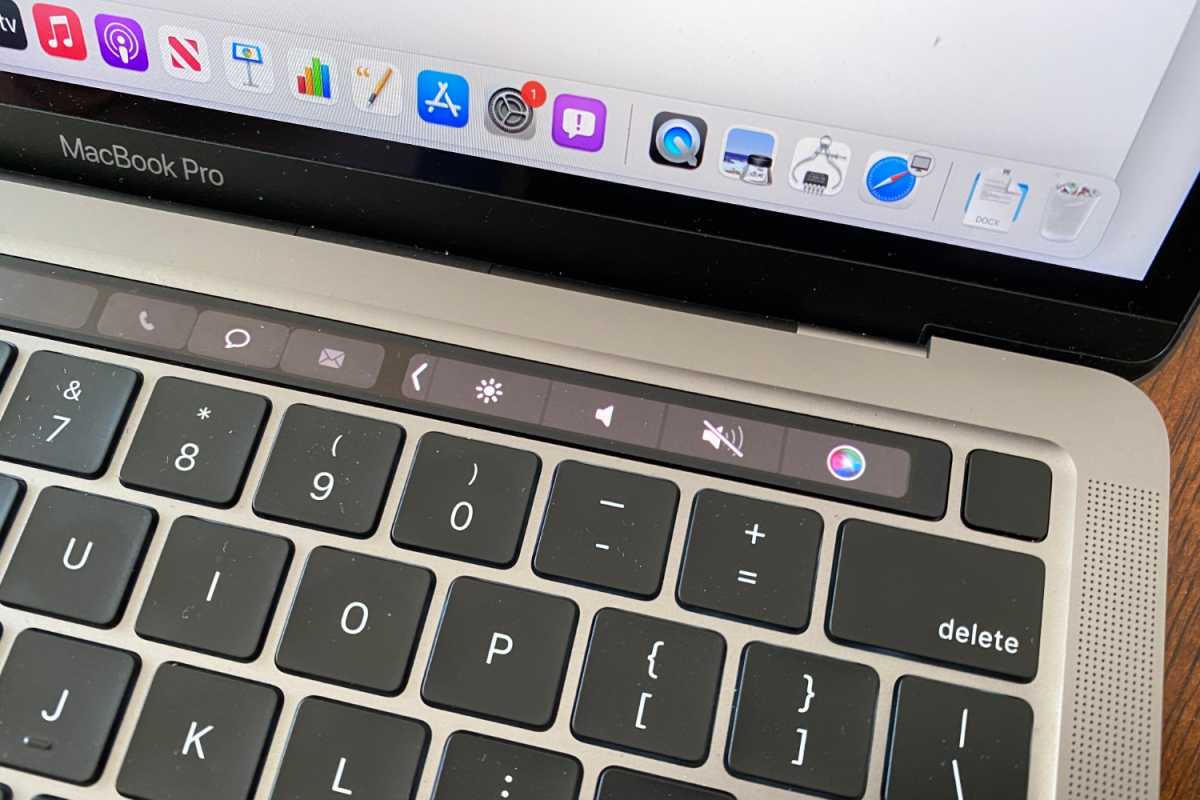
Apple dropped the Contact Bar from the MacBook Professional with the introduction of the 14- and 16-inch MacBook Professional in 2023.
IDG
The Contact Bar, in the meantime, was a touch-sensitive OLED show that sat on the prime of the keyboard, changing the row of perform keys. It was populated with a spread of buttons and actions that modified dynamically relying on which app was in use. Sadly, it by no means actually took off: it wasn’t compelling sufficient to persuade customers, whereas it lacked the form of third-party integrations that would have transformed them.
The 2016 MacBook Professional wasn’t all dangerous. The trackpad was roughly twice as giant because the one on its predecessor, providing you with extra room for swipes and gestures. However this MacBook Professional was additionally identified for changing each port with a USB-C slot–given how little USB-C was in use on the time, it meant you wanted an adapter for nearly something you wished to attach. Tellingly, the butterfly keyboard, Contact Bar, and USB-C exclusivity have all been dropped or rolled again by Apple within the years since.
Apple silicon (2020)
If the 2016 MacBook Professional was divisive, the 2020 version has acquired near common acclaim because it launched, and that’s nearly fully all the way down to a single change: the introduction of Apple silicon and the M-series chips within the Mac. Whereas previous MacBook Execs have been identified to be good however not world-beating, Apple silicon modified all that and helped Apple’s laptop computer ascend to the head of transportable computing – a place it nonetheless occupies right this moment.
The variations have been profound. Intel chips had made MacBook Execs sizzling and loud whereas providing efficiency that wouldn’t precisely trigger clients to hurry to an area Apple Retailer. Apple silicon, although, managed to do the not possible: it massively ramped up efficiency whereas doing so in a way more environment friendly bundle, leading to a cooler, quieter operation that put far much less pressure on the battery. Battery life was so a lot better, in actual fact, that Apple engineers initially thought their testing software program was damaged.
Regardless of the paradigm shift that the brand new chip introduced, Apple took it straightforward when it got here to the MacBook Professional design. The 2020 MacBook Professional used the very same design because the mannequin that got here earlier than it, together with the Contact Bar and display screen sizes. These would each be modified inside the subsequent 12 months.
With the appearance of Apple silicon, Apple confirmed that it nonetheless knew what it took to make a blazing-fast laptop computer that smoked the competitors. It helped counter arguments that the MacBook Professional was overpriced and underperforming, and right this moment makes it a powerful possibility if you happen to’re after a tool that may deal with demanding workflows with out sounding like a jet engine taking off.
The way forward for the MacBook Professional
Now that we all know how the MacBook Professional obtained to the place it’s right this moment, the place is it going? If the rumors are right, the subsequent version could possibly be simply as vital because the fashions we’ve lined on this article.
The largest new options are stated to be coming to the show. First, the MacBook Professional will lastly get an OLED display screen. This will probably be an improve over the present mini-LED show at the moment in use and will deliver higher distinction and black ranges to the laptop computer.
Other than that, Apple can also be anticipated to outfit this MacBook Professional with touchscreen know-how. The corporate has lengthy eschewed this function, and Steve Jobs himself referred to as it “ergonomically horrible.” But the rumors that Apple is constructing on this performance haven’t gone away, and it now appears extra probably than not that Apple is about to carry out a dramatic about-turn.
Few different particulars are identified, apart from the concept the MacBook Professional’s chassis will probably be slimmed down from its present stage. It’s additionally anticipated to launch someday round late 2026 or early 2027. The high-end show options are considered reserved for the M6 Professional and M6 Max fashions, though they’ll in all probability trickle all the way down to the entry-level MacBook Professional within the coming years.

