




At a look
Professional’s Ranking
Execs
- Helps as much as 4 exterior shows at 4K 60Hz
- As much as two shows at 6K 60Hz
- 16 ports, inc. three 40Gbps Thunderbolt 4
- 3x DisplayPort video ports
- 2x HDMI video ports
- 2.5Gb Ethernet
- Speedy SD card readers
- 96W laptop computer charging
Our Verdict
Bristling with devoted video ports, the Kensington SD5900T is our new number-one selection for high-bandwidth DisplayLink docking station. MacBook Neo homeowners needn’t hassle with spending the additional on a Thunderbolt dock, however for everybody else wanting so as to add extra exterior shows than Apple’s restricted Macs permit the SD5900T is a tremendous versatile selection.
Value When Reviewed
This worth will present the geolocated pricing textual content for product undefined
Greatest Pricing At this time
Value When Reviewed
$299.99
Greatest Costs At this time: Kensington SD5900T EQ Thunderbolt 4 Quad 4K Dock with DisplayLink

$260.99

$260.99

$299.99

$300.99

$326.29
Greatest for: Folks hitting Apple’s show limits.
Not for: Customers who don’t want greater than 1–2 screens.
Key limitations: DisplayLink downsides (HDCP/streaming points, 60Hz cap); Weak 149W energy provide.
Relating to connecting a number of shows it’s necessary to take a look at your Mac’s processor. The bottom/Professional/Max sort of Apple M-series chip isn’t nearly uncooked processing energy—it additionally decides the restrict of what number of screens you may connect.
And that restrict for the MacBook Neo or older base M1 and M2 Macs is only one.
Since Apple ditched Intel chips for its personal Silicon M-series processors customers have ceaselessly stumbled throughout this irritating limitation—however concern not as there’s a well past Apple’s display screen restrict.
The M-series chips are both base (M1, M2, M3, and so forth) or extra superior (M1 Professional, M2 Professional, M4 Max and so forth). All of the chips have a most variety of exterior shows that they help, however the non-Professional/Max chips are the weakest. The MacBook Neo doesn’t even have an M-series processor, working off a much less highly effective A18 chip (the identical utilized in some iPhones).
- Base M1 and M2: one exterior monitor
- Neo: one exterior monitor
- Base M3: two exterior screens when MacBook’s lid is closed
- Base M4, Base M5, M4 Professional, M4 Max chip: two exterior screens
- M5 Professional: three exterior screens (through Thunderbolt 5, in any other case two)
- M5 Max: 4 exterior screens (through Thunderbolt 5, in any other case two)
Fortunately, there’s a workaround for all of the above Macs, involving some free software program and a supporting hub or dock, meaning any Mac can help a minimum of three shows—even the Neo.
The most well-liked free software program that solves the Apple chip limitation is DisplayLink. Set up is straightforward—there’s some preliminary fiddling round in System Settings—however after you could join as much as 5 exterior shows relying on the prowess of the hub or dock.
We’ve gone into extra element about the right way to join a number of screens to M1/M2/Neo Macs in our devoted the right way to and listing of the most effective DisplayLink docks.
Most DisplayLink docks use USB-C to connect with the Mac, which isn’t an issue for the MacBook Neo that has USB-C itself however is a decrease knowledge bandwidth for the opposite Thunderbolt Macs. Typical USB-C DisplayLink docks have a data-transfer price of 10Gbps (gigabytes per second), whereas Thunderbolt 4 is rated at 40Gbps and Thunderbolt 5 at 80Gbps.
10Gbps is perhaps all you want from a dock however in case you are related to exterior storage drives, as an illustration, then Thunderbolt speeds change into extra necessary.
Proper now, there’s no 80Gbps Thunderbolt 5 DisplayLink dock in the marketplace however there are some 40Gbps Thunderbolt 4 DisplayLink docks.
We’ve examined the most effective Thunderbolt DisplayLink docks, and price each the Satechi Thunderbolt 4 Docking Station with DisplayLink and Plugable Thunderbolt 4 Docking Station (TBT-6950PD). These docks are nearly an identical and differentiated solely by the Plugable dock having a cable 8 inches (200mm) longer than the Satechi!
Each function one upstream Thunderbolt 4 port and three downstream, plus two HDMI 2.0 video ports, two 10Gbps USB-A, Gigabit Ethernet, SD card reader, 3.5mm audio jack and a 180W energy provide. They help as much as 4 exterior prolonged shows at 4K/60Hz: two through Thunderbolt 4 and two through HDMI so long as the DisplayLink software program has been put in.
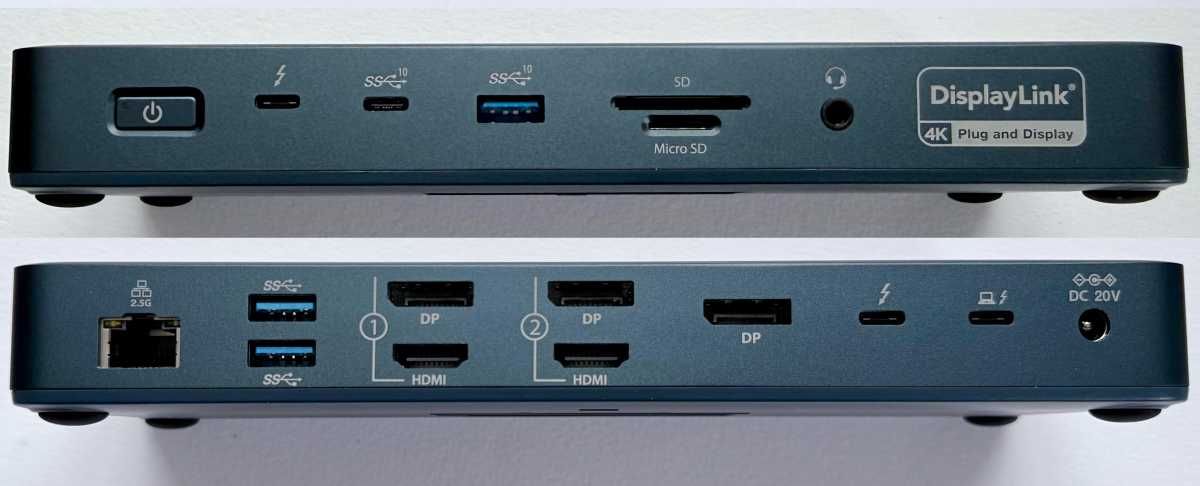
Kensington’s SD5900T EQ Dock additionally makes use of Thunderbolt 4 and DisplayLink to help as much as 4 exterior shows, nevertheless it encompasses a completely different set of ports to realize this—providing extra devoted video ports to your monitor connection of selection.
Simon Jary
Specs
- One upstream Thunderbolt 4 port (40Gbps, 96W)
- Two downstream Thunderbolt 4 ports (40Gbps, 15W)
- Two HDMI ports
- Three DisplayPort
- One USB-C port (10Gbps, 4.5W) on entrance
- One USB-A port (10Gbps, 4.5W) on entrance
- Two USB-A ports (5Gbps, 4.5W) on rear
- 2.5Gb Ethernet
- SD Card reader (UHS-II, 312MBps)
- MicroSD Card reader (UHS-II, 312MBps)
- 3.5mm audio jack on entrance
- 149W energy provide
The SD5900T’s 16 ports outgun the Satechi and Plugable Thunderbolt 4 DisplayLink docks, which each host simply 11.
Simon Jary
Show configurations: What number of shows are you able to run with this dock?
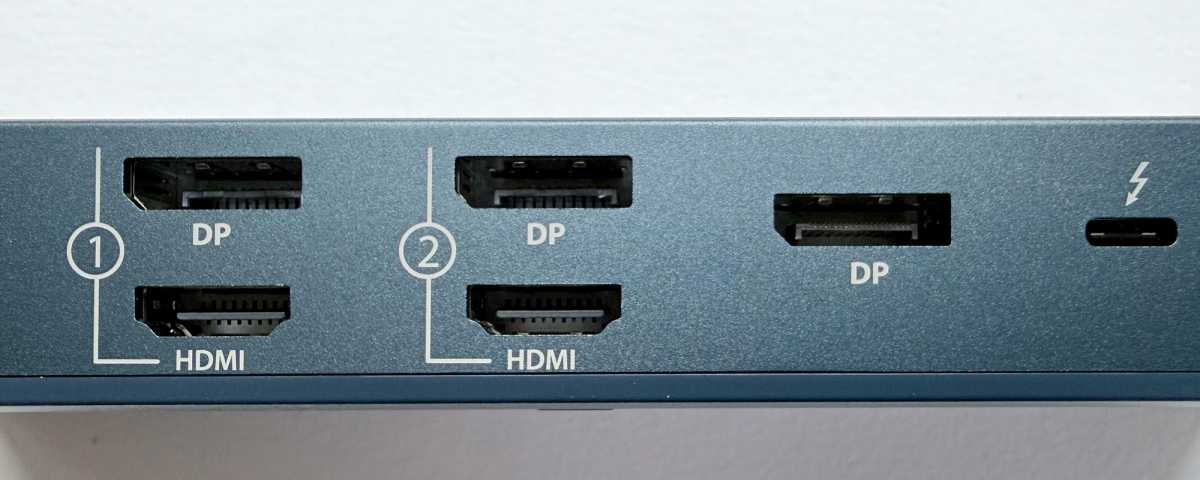
Whereas it sacrifices one of many Thunderbolt ports for an additional DisplayPort, there are two extra DisplayPorts (DP) in addition to two HDMI—that’s extra selection of devoted video ports, with one of many TB4 ports additionally obtainable for a show connection.
You get to decide on between DP and HDMI in every of the 2 video port banks after which get to make use of both the third DP and/or one of many entrance/rear downstream TB4 ports.
What number of exterior shows you may join relies upon, as ever, in your Mac’s processor.
With this DisplayPort dock, the MacBook Neo and Macs with the bottom M1/M2/M3/M4/M5 chips can help three shows: two 4K/60Hz through the DP/HDMI ports and a 3rd as much as 6K/60Hz through both the third DP or TB4.

Kensington
Macs with a Professional or Max M-series chip get the choice of a fourth show, with two 4K/60Hz through DP/HDMI plus as much as two 6K/60Hz utilizing the opposite ports. You can even join 4 shows to Macs with the bottom M3 chipset, however you will need to maintain the laptop computer lid closed for this to work.
The additional exterior shows allowed with the M5 Professional and M5 Max are for Thunderbolt 5 solely, so not supported by this dock (or any DisplayLink dock on the time of writing).
The Satechi and Plugable DisplayLink TB4 docks function fewer devoted video ports so should select between TB4 and HDMI ports. That third TB4 port affords the person extra flexibility however Kensington rightly is aware of a DisplayLink dock purchaser is principally utilizing the dock for its a number of show performance moderately than as a typical docking station.
Simon Jary
DisplayLink required: What do it’s essential to set up, and what are the downsides?
The purpose of a DisplayLink dock is, in fact, the advantages bestowed by that free software program obtain and fairly simple set up.
The place a base M1/M2 Mac or MacBook Neo can natively deal with just one monitor, DisplayLink lets them hook up with as much as three, and Professional/Max-chipped Macs as much as 4.
DisplayLink is a straightforward set up with the one fiddly bit when you need to grant “Display Recording” rights to it through Techniques Settings–it sounds scary however don’t fear because it doesn’t truly document something. As an alternative, it simply permits the DisplayLink Supervisor app to seize pixels and ship them to the dock.
There are some potential negatives to having DisplayLink put in in your Mac:
- Until you disconnect the DisplayLink-enabled screens or unhook the dock, you may’t watch some protected content material in Netflix, AppleTV, Amazon Prime, Disney+ or YouTube TV and different streaming purposes because of these platforms utilizing Excessive-bandwidth Digital Content material Safety (HDCP), which is Intel-developed digital copy safety.
- DisplayLink’s most display screen refresh price is 60Hz, which is ok for many customers however can introduce noticeable lag with quickly altering content material, which isn’t ideally suited for video enhancing or gaming.
In case you are utilizing your a number of screens for basic productiveness work, you then’ll seemingly by no means stumble upon these DisplayLink downsides.
Simon Jary
USB extras: What ports do you truly get (and what’s lacking)?
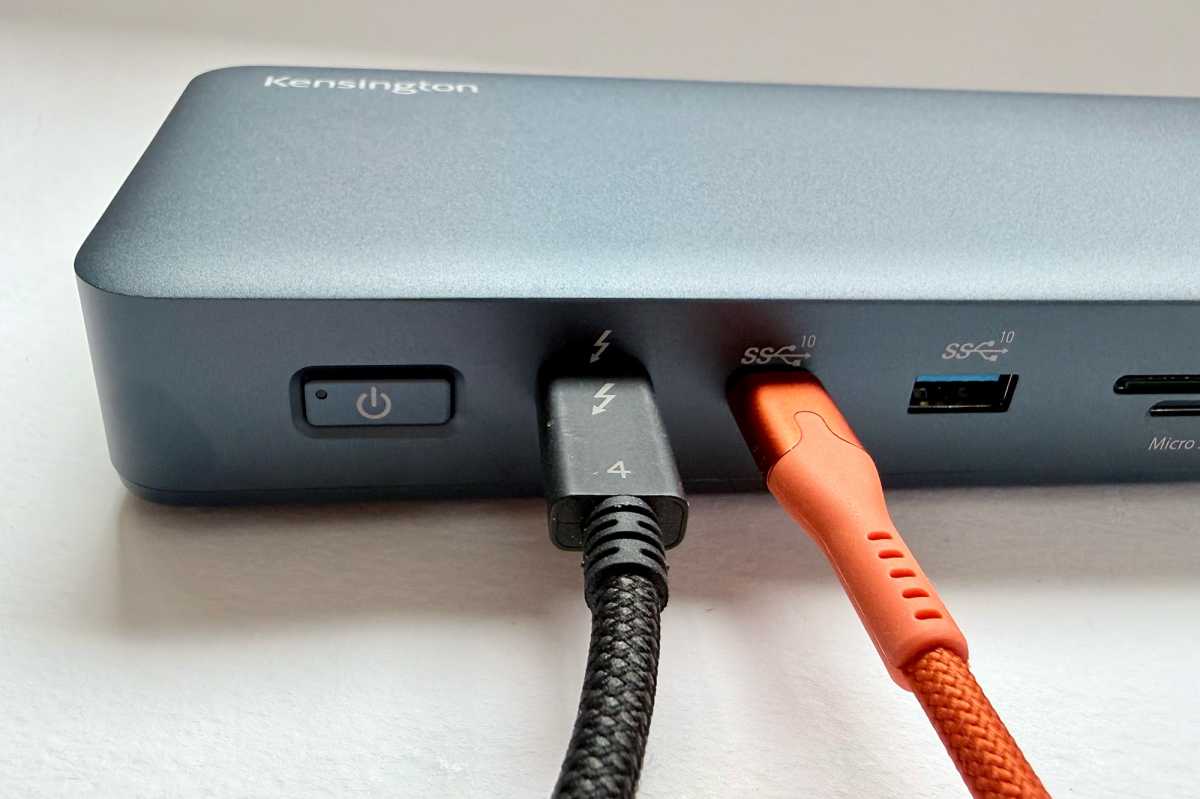
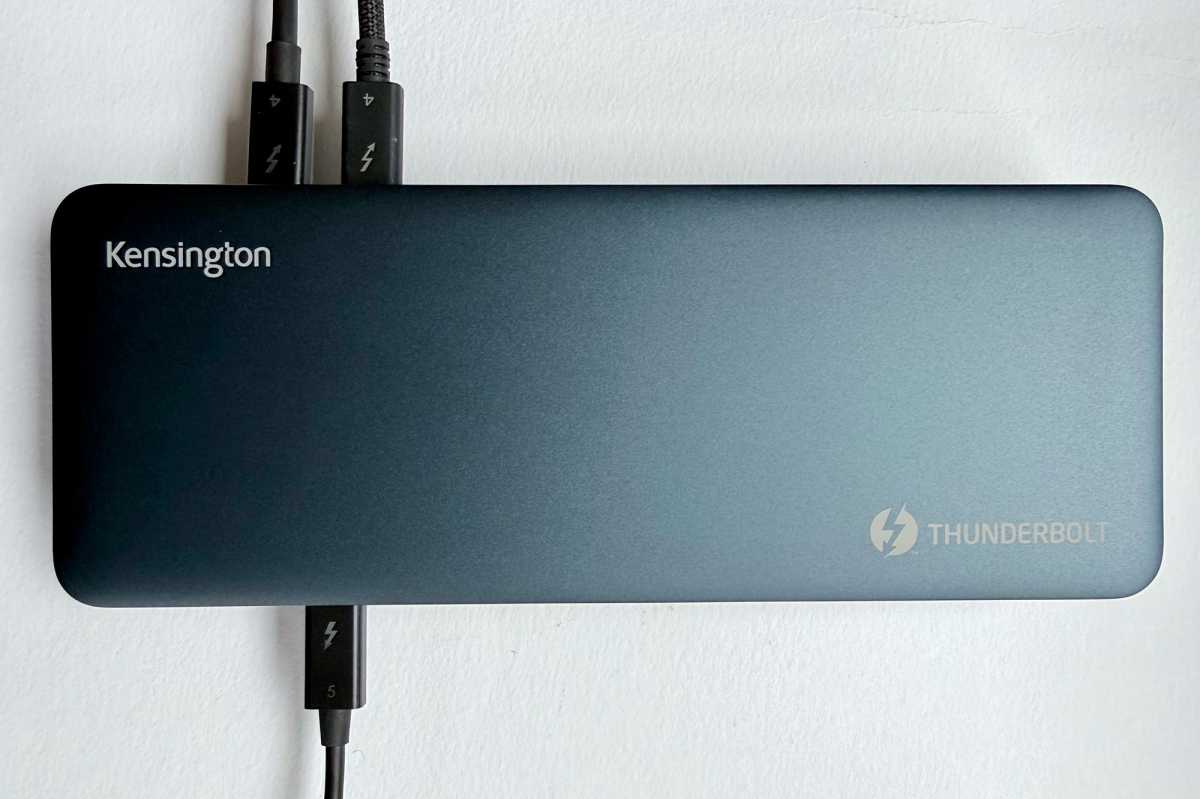
The SD5900T hosts three type-C ports: two downstream Thunderbolt 4 and one 10Gbps USB-C. That’s the identical quantity as discovered on the Plugable and Satechi TB4 DisplayLink docks, though these docks function three downstream TB4 ports as an alternative. TB4 is best than USB-C nevertheless it’s seemingly you’ll use it for video anyway so except you’re utilizing it to only transfer from one show to 2 on base M1/M2 Macs it doesn’t actually make a distinction.
Simon Jary
Energy
The upstream TB4 port can passthrough as much as 96W of energy to the related MacBook, which must be sufficient to maintain any of Apple’s laptop computer going even underneath a heavy workload.
Every of the 2 downstream TB4 ports can output 15W of energy, however the different USB ports are puny at 4.5W. It could have been nice if the front-mounted USB-C port might output even 20W of energy to permit for iPhone fast-charging however it’s best to look to different USB-C or wi-fi chargers for this moderately than hook your telephone as much as the dock for charging.
Verify our suggestions for the finest iPhone USB-C chargers and finest wi-fi iPhone chargers for superior energy choices.
The shortage of USB output energy is in some methods lucky because the SD5900T’s energy provide is rated at simply 149W, which is the bottom we’ve seen of self-powered docking stations. Most docks supply a minimum of 180W, however because the ports supply little in the best way of charging it’s once more much less of a fear.
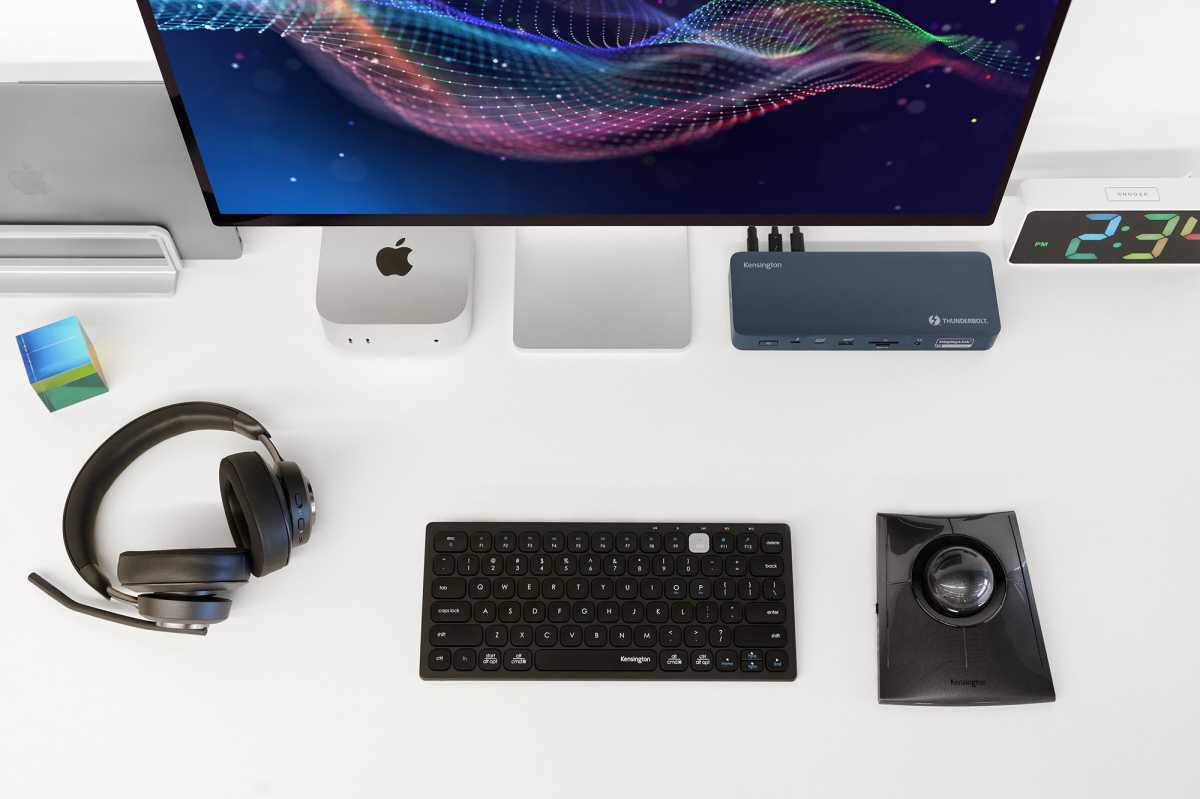
Kensington’s KonstantCharge expertise permits gadgets related to the dock to cost even when your MacBook is undocked.
Kensington
Storage choices
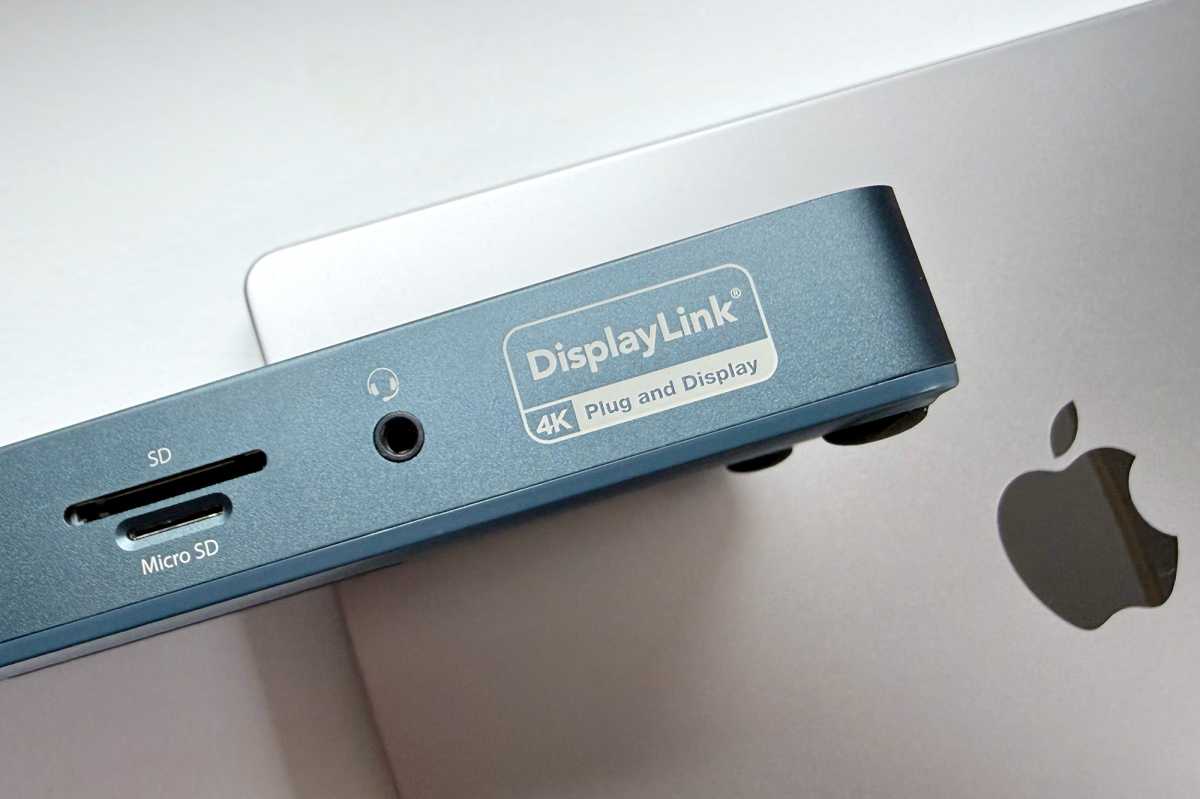
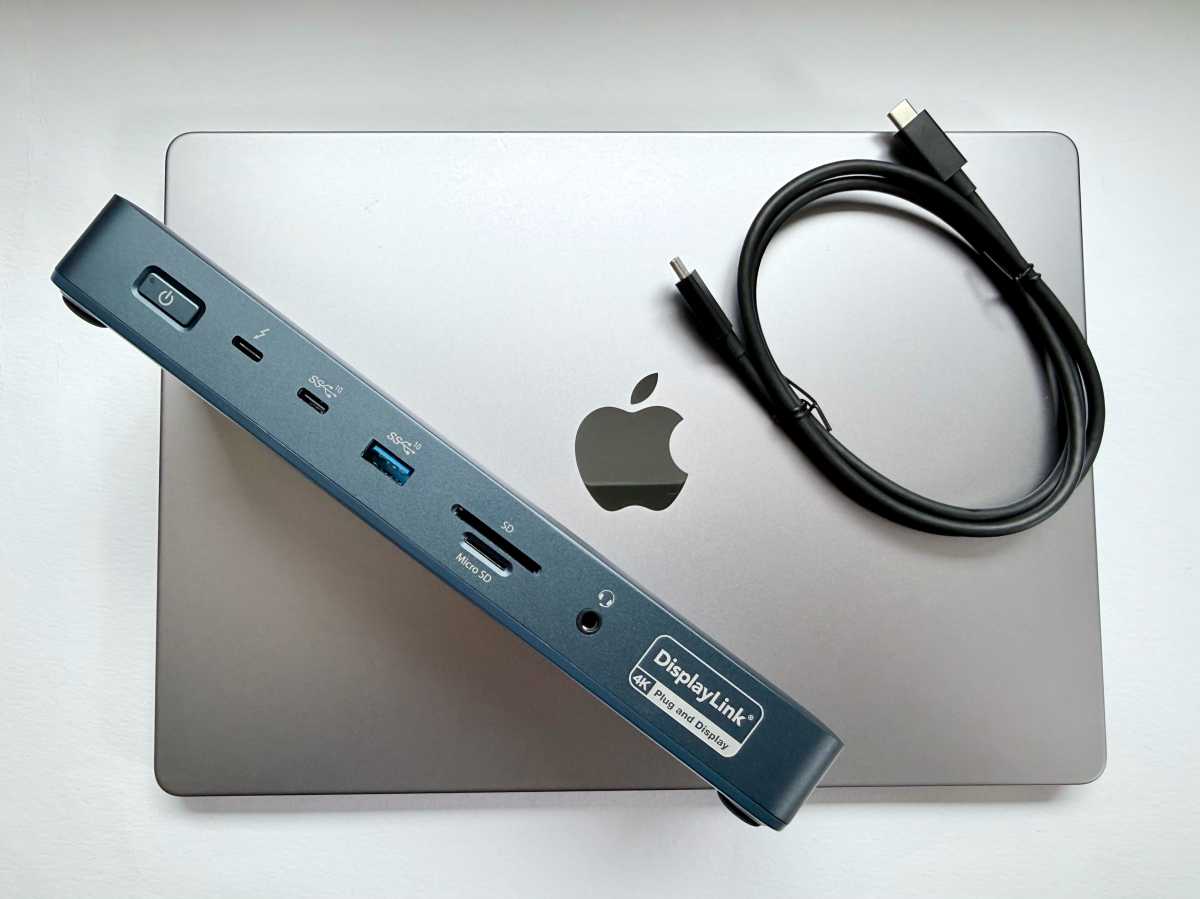
The dock has each SD and MicroSD card readers at its entrance for easy-access transportable storage playing cards. With MacBook inner storage being lower than beneficiant except you fork out some huge cash on the level of buy, that is an inexpensive storage resolution with 512GB playing cards ranging from round $100 on Amazon.
Kensington has added these card readers on the top-end when it comes to pace, rated at UHS-II’s 312MBps compared to Apple’s 250MBps SDXC card reader on the MacBook Professional. The Satechi and Plugable TB4 DisplayLink docks function simply the one SD card reader, but additionally at 312MBps.
Simon Jary
Community
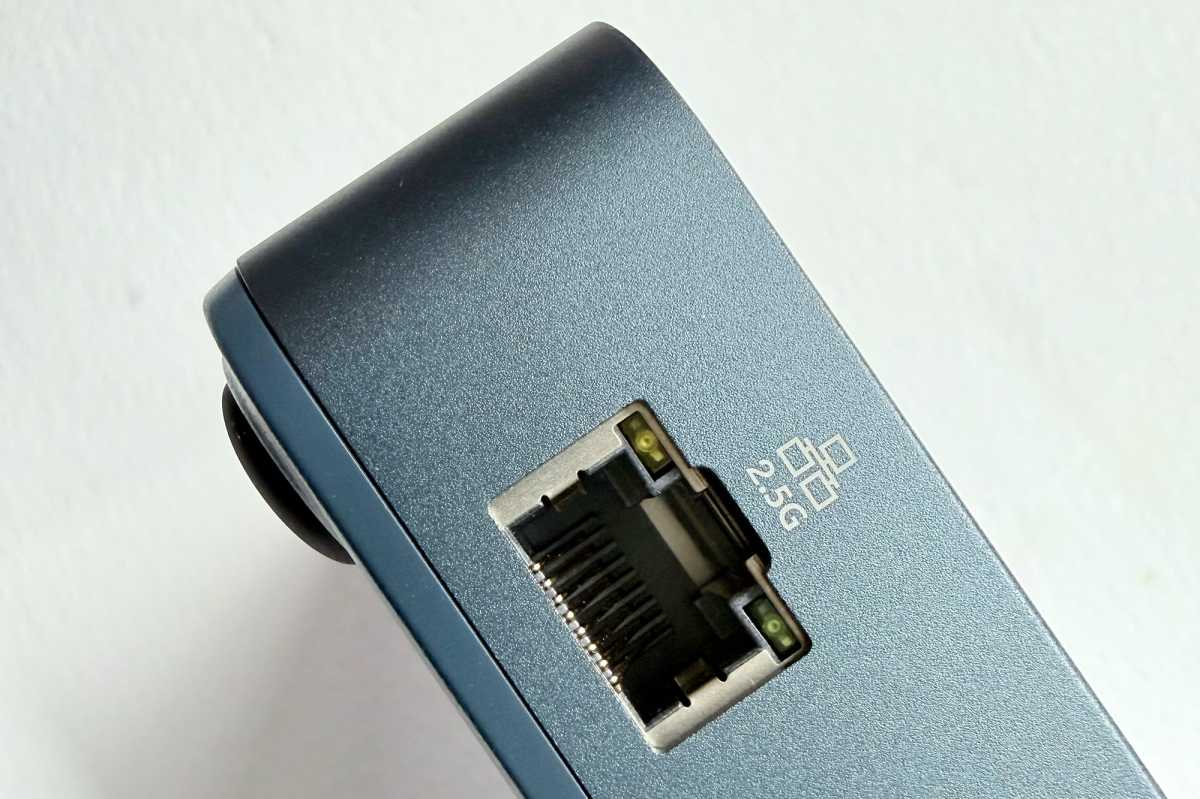
One other space the place the Kensington SD5900T beats the Satechi and Plugable DisplayLink docks is its inclusion of sooner 2.5Gb Ethernet in comparison with 1Gb Ethernet. Once more, most customers received’t profit as the usual workplace community stays Gigabit Ethernet however having the backwards-compatible 2.5GbE is helpful when you do run a quick wired community otherwise you wish to future-proof your self for if/whenever you do.
Value
The Kensington SD5900T is priced at $299.99 / £269.99, which is identical because the Satechi and Plugable TB4 DisplayLink docks talked about compared above.
Until you’re a base M1/M2 Mac person wanting so as to add simply two exterior shows, Kensington’s better selection of video ports is the higher resolution on the similar worth. And the SD5900T contains superior Ethernet and two card readers if these are necessary elements to you.
There are a number of variations of the Kensington SD5900T, and these appear to be differentiated solely by shade. We examined the Midnight Blue SD5900T however the Black SD5910T is precisely the identical apart from the extra normal dock shade. E.U. and U.Ok. prospects ought to search for the SD5920T mannequin, which sadly is in black solely.
You’ll discover extra of our suggestions for the finest DisplayLink docks and non-DisplayLink finest Thunderbolt docks if you wish to dig deeper for different options.
Simon Jary
Do you have to purchase the Kensington SD5900T?
Bristling with devoted video ports, the Kensington SD5900T is our new number-one selection for high-bandwidth DisplayLink docking station. M5 Professional/Max customers can most likely look to a typical Thunderbolt 5 dock and MacBook Neo homeowners needn’t hassle with spending the additional on a Thunderbolt dock, however for everybody else wanting so as to add extra exterior shows than Apple’s restricted Macs permit the SD5900T is a tremendous versatile selection.

